FinanceHarness: My experiments with building a dedicated agentic retrieval harness for finance tasks
Some days are just amazing. This was one of them:
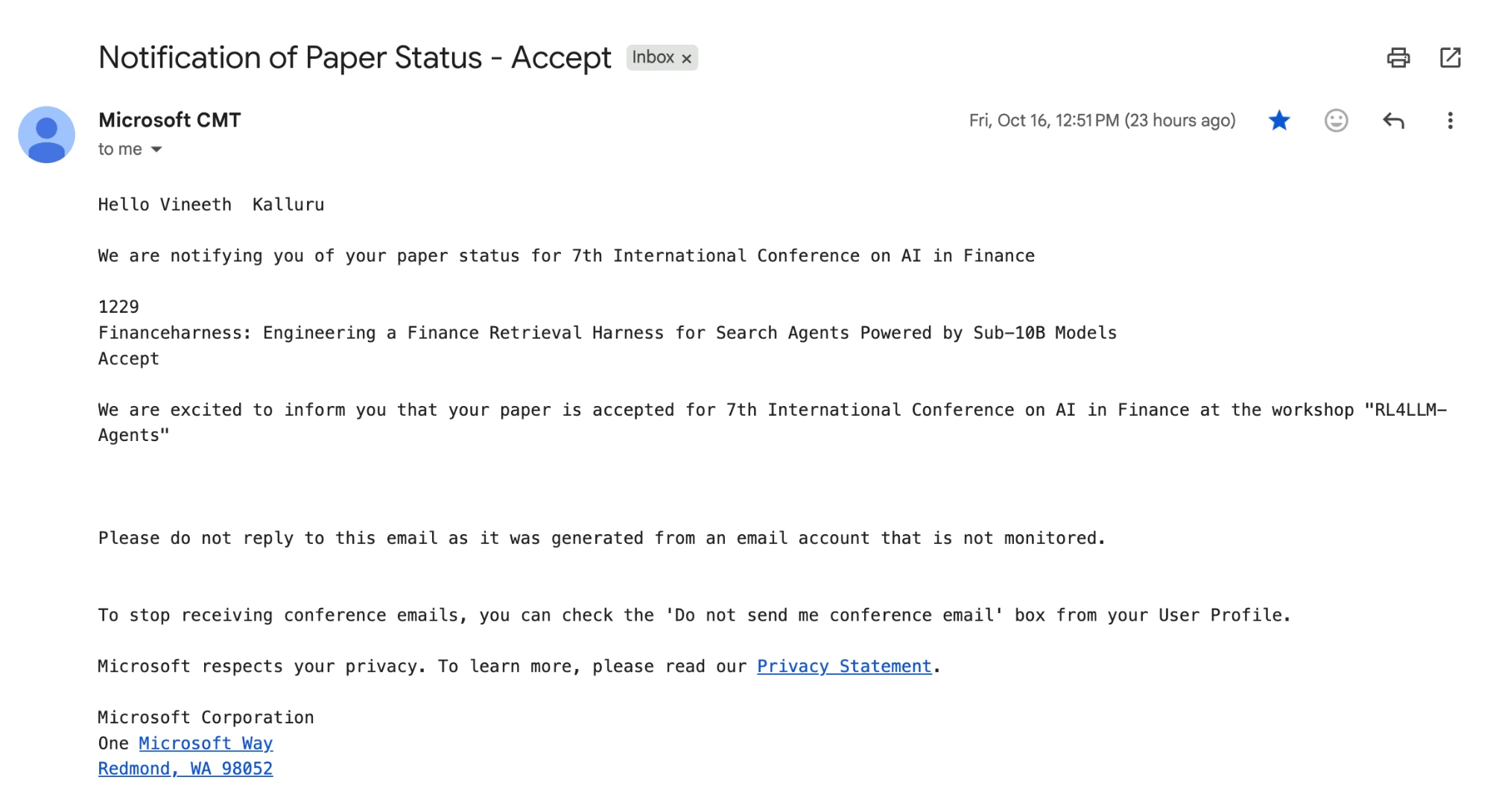
Our paper, Financeharness: Engineering a Finance Retrieval Harness for Search Agents Powered by Sub-10B Models, got into the RL4LLM-Agents workshop at the 7th International Conference on AI in Finance. This was an independent side project with five amazing co-authors: Snigdha Potluri, Prachi Modi, Barathwaj Anandan, Rohan Rao and Mrunmayee Rane. A lot of evenings, and a stubborn belief that small models deserve better tools.
Here’s the story, including the parts that didn’t work.
TL;DR
- Small open models (under 10B parameters) are great to deploy, but they’re terrible at long, messy research tasks like “find this number in a company’s annual report”.
- Instead of fine-tuning them, we rebuilt the environment they work in: a harness that tracks evidence, remembers where the agent has been, and refuses answers without receipts.
- Same Qwen3.5-4B, same weights: 55 → 100 correct out of 150 FinanceBench questions, with half the tool calls.
- The same harness, untouched, works across model sizes: 59–81% correct for Qwen3.5-4B, Qwen3.5-9B and GLM 5.3 Flash.
- The big remaining failure isn’t wrong answers. It’s agents that find the evidence and then never answer.
The problem: a lookup that isn’t a lookup
Take a question like “What is Activision Blizzard’s three-year average of capex as a share of revenue?” It sounds like a lookup. It’s actually six decisions in a trench coat: pick the right company, the right filing, the right fiscal years, the right table, read the units correctly, and do the arithmetic. Each step can fail on its own.
Big models paper over this by holding a huge trajectory in context. A 4B model can’t. It forgets what it already searched, which pages it read, and which text supports its answer. So it does what any of us would do with no memory: it searches again. And again.
The idea: fix the room, not the model
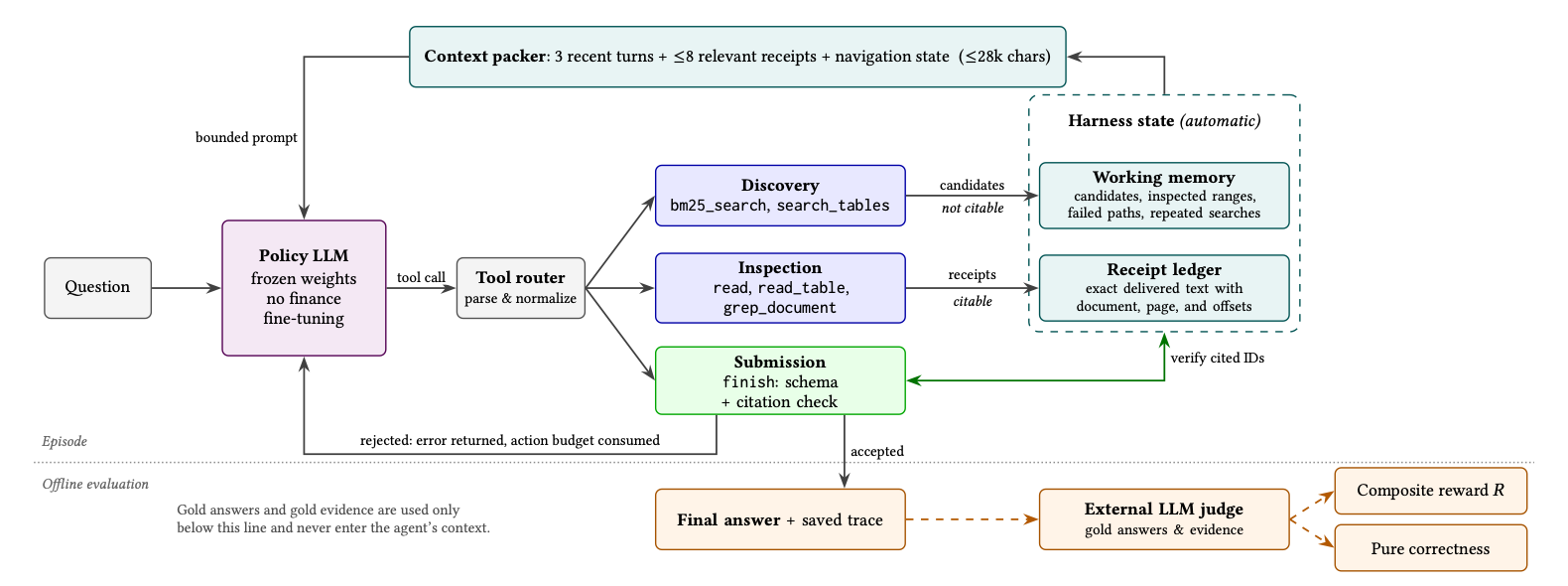
We didn’t touch the weights. We built Financeharness around three rules:
- Discovery is not evidence. Search results are just candidate locations. Only actually reading the source text produces a receipt: the exact text the agent saw, pinned to a document, page and offsets.
- State is managed, not requested. The harness keeps a receipt ledger and a working memory (what’s been searched, what failed, which pages were read) and packs a small, bounded view of them into every prompt. The model never has to call a “memory” tool.
- Submissions are validated. The final answer is only accepted if every citation points to a receipt the agent really collected. No receipt, no answer.
A few choices I’m proud of for being boring:
- No vector database, no embeddings, no pre-indexing. The agent searches raw PDFs with BM25 and grep. Adding a filing means dropping in a PDF. (Keyword search turns out to be surprisingly enough for agents.)
- No calculator. Arithmetic stays the model’s job. Spoiler: it was rarely the problem.
- Six tools total:
| Tool | What it returns | Creates a receipt? |
|---|---|---|
bm25_search | Ranked candidate pages | No |
search_tables | Candidate table pages | No |
grep_document | Exact matches in a document | Yes |
read | A window of source text | Yes |
read_table | Page text around a table | Yes |
finish | Checks the answer schema and citations | No |
My favorite failure: 48 searches for a file that doesn’t exist
Back to Activision Blizzard. With only minimal tools (search, grep, finish), the 4B model searched for the FY2017 and FY2018 annual reports. The search kept returning the FY2019 report, which already contains all three years. The model’s own reasoning, verbatim:
“The search is returning the 2019 10-K document. I need to find the actual 2017 and 2018 10-K filings.”
Then it searched for them 48 more times. It never opened a single page. Fifty calls, no answer, reward zero.
Same model, full harness: its year-filtered searches came back empty, the harness logged them as failed paths in working memory, and on the next turn the model changed strategy. It searched for the income statement and cash-flow statement, read two pages, and submitted the correct 1.9% with citations. Nine calls.
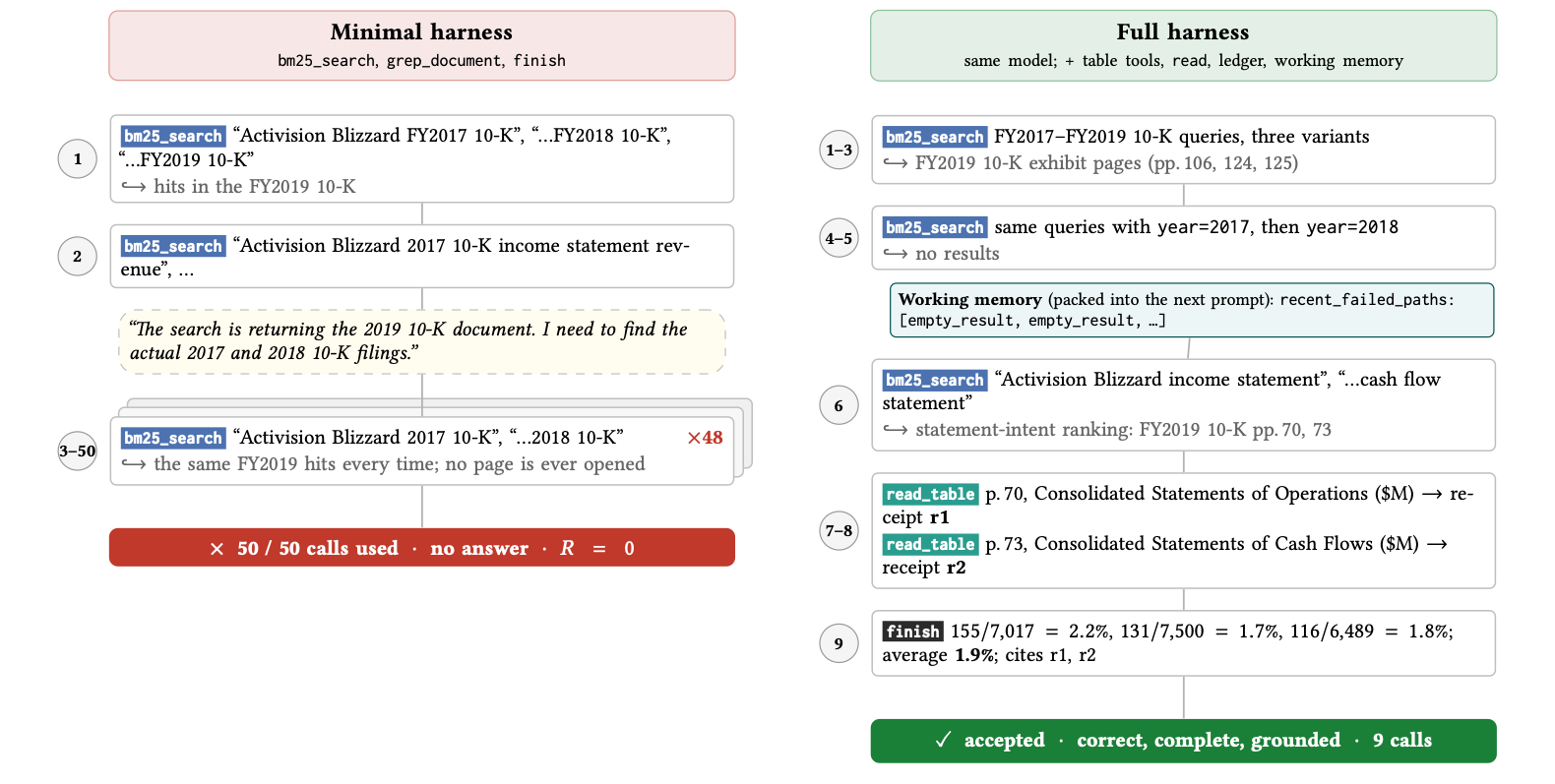
Nothing about the model changed. It just finally had a memory of its own dead ends.
Results
Every arm ran all 150 questions of the public FinanceBench release (600 episodes in all), with one LLM judge, blinded to which harness produced each answer.
Same model, different harness (Qwen3.5-4B):
| Minimal harness | Full harness | Change | |
|---|---|---|---|
| Correct answers | 55 (37%) | 100 (67%) | +45 |
| Mean reward | 0.41 | 0.67 | +64% |
| Accepted answers | 68 (45%) | 114 (76%) | +46 |
| Tool calls (mean / median) | 28.2 / 21 | 14.8 / 7 | −48% |
| Hit the 50-call cap | 68 | 24 | −44 |
| Tokens per episode | 233k | 104k | −55% |
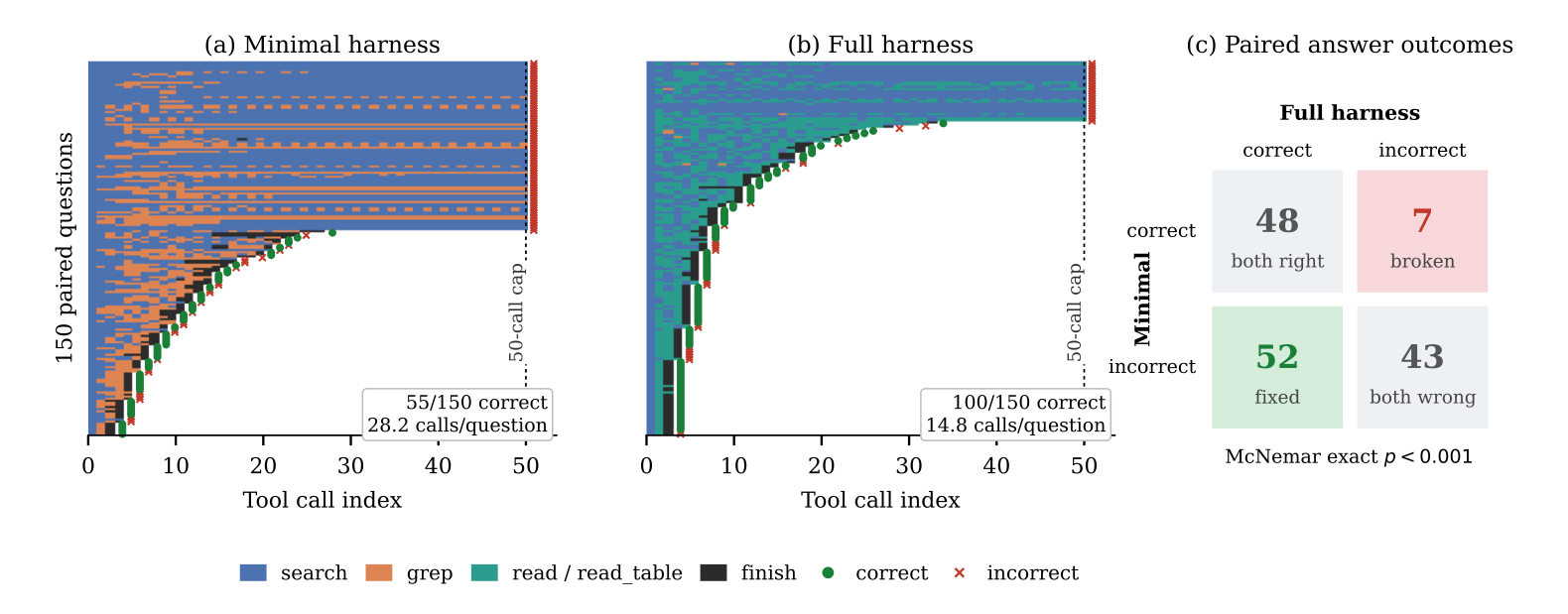
Better and cheaper, which almost never happens. Question by question, the harness fixed 52 answers and broke 7 (McNemar p < 10⁻⁸).
This is my favorite figure in the paper. Every row is one question, every cell one tool call. On the left, the minimal agent: a wall of blue searches slamming into the 50-call cap. On the right, the same model with the harness: a few searches, a couple of reads, done.
Same harness, different models:
| Qwen3.5-4B | Qwen3.5-9B | GLM 5.3 Flash | |
|---|---|---|---|
| Correct answers | 100 (67%) | 89 (59%) | 121 (81%) |
| Accepted answers | 114 (76%) | 94 (63%) | 141 (94%) |
| Tool calls (mean) | 14.8 | 11.7 | 7.7 |
No per-model tuning. And yes, the 4B beat the 9B, which we’ll get to.
Where it still falls over: they find it, but don’t finish
Accuracy tells you how often an agent is right, not where it goes wrong. So in a follow-up analysis we placed every episode at the first stage where it broke: finding the filing, opening it, reading the right page, answering, submitting. Because every read leaves a receipt, most of this needs no judge at all.
The picture was not what I expected:
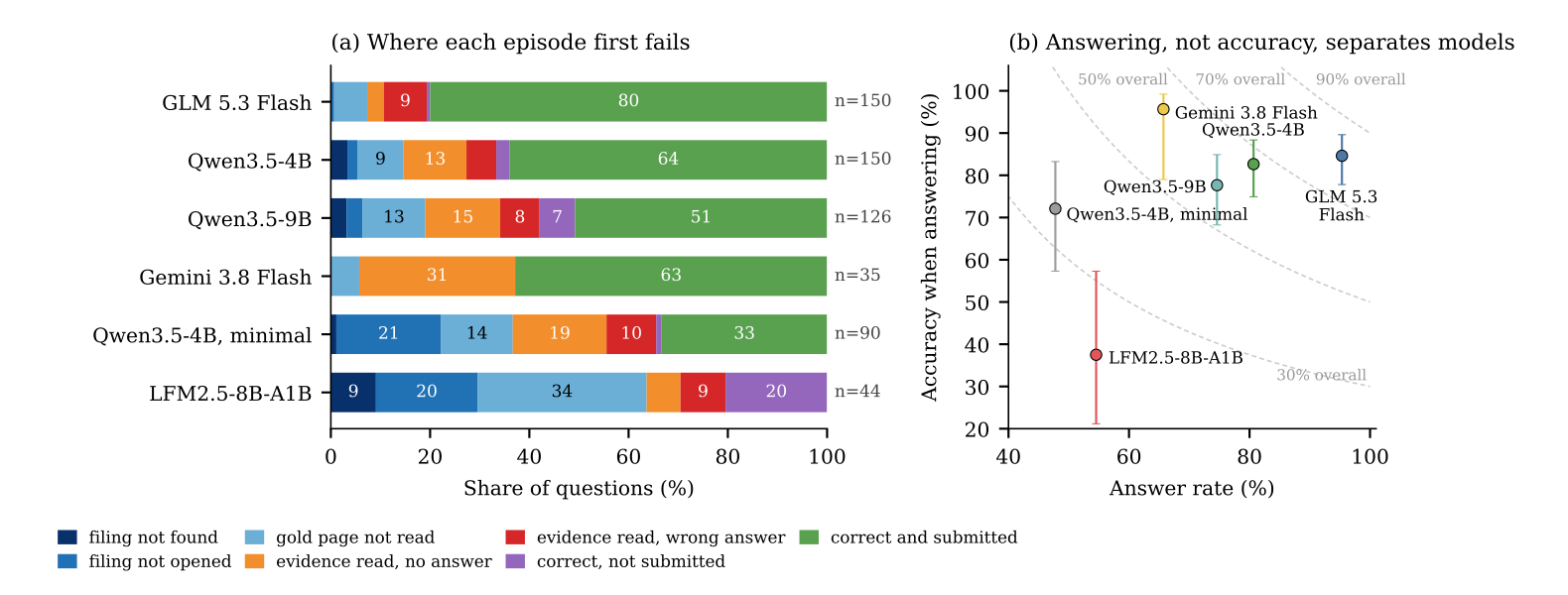
- Retrieval is basically solved. Every main model surfaced the right filing for 97% of questions.
- The biggest failure is no answer at all. For Qwen3.5-4B, 29 of its 50 misses were unanswered, and in 19 of those the agent had already read the page with the answer.
- Answering, not accuracy, separates the models. When they do answer, Qwen3.5-4B and GLM are about equally accurate (83% vs 85%). GLM wins because it answers more often (95% vs 81%).
And they fail to finish in two very different ways:
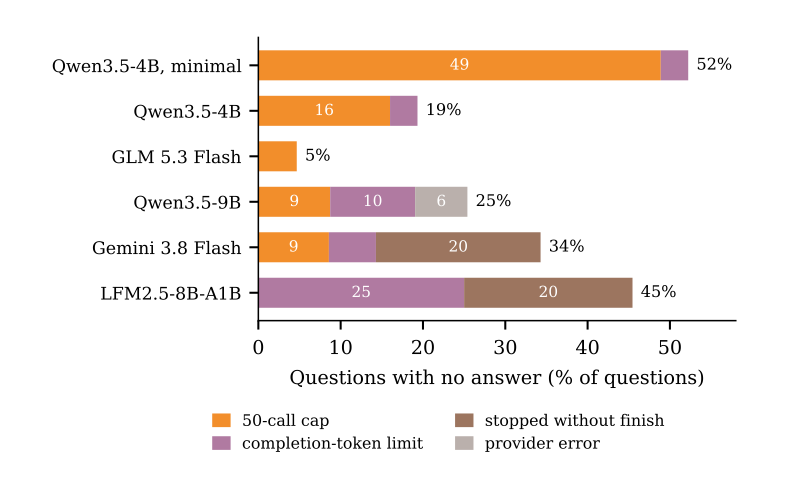
- Over-searching. One agent read the correct page of American Express’s 10-K on its third call, then went looking for registered debt securities that don’t exist (the right answer was “none”). 45 searches later, it hit the cap. Some agents just can’t take “it’s not there” for an answer.
- Truncation. Qwen3.5-9B tends to think until it runs out of its 1,024-token response budget. In one episode it read the exact AMD table it needed, then emitted an empty message. That’s most of why the 9B trails the 4B.
A few other humbling things:
- Arithmetic was almost never the problem. No calculator, and only 3 arithmetic mistakes among 64 wrong answers. The real errors were semantic: the wrong line item or entity (16) and misreading the evidence (16).
- Sometimes the benchmark is wrong too. 16 “wrong” answers involved references the judge flagged as wrong or ambiguous.
- Tool calling can be the whole game. LFM2.5-8B-A1B found correct answers it never submitted,
because it rarely called
finish.
The lesson for me: invest in commitment, not more retrieval. Tell the agent when its ledger already holds enough evidence, force a best-effort answer before the budget runs out, and give thinking its own budget.
Honest caveats
- One seed per arm. The question-by-question comparison is our strongest evidence.
- An LLM judge (Claude), not FinanceBench’s human graders. Same judge for every arm, but it’s still not human review.
- The minimal-vs-full comparison changes several things at once, so it measures the whole harness, not any single piece. Ablations are next.
- Benchmark questions may have leaked into pretraining. Filing QA isn’t live market research.
What’s next: training inside the harness
Everything so far uses frozen weights. Next, we train inside the harness: start from Qwen3.5-4B, generate source-backed questions from filings outside the test set, and optimize with GRPO. The failure analysis tells us what to reward: make unanswered episodes costly, and give credit for committing once the evidence is in hand. A reward that only pays for correct, submitted answers can be gamed by searching longer, and we’ve already watched our agents try.
Huge thanks to my co-authors for the late nights, and to the RL4LLM-Agents reviewers. If you’re building search agents on small models, I’d love to compare notes. DM me on X.